How Rule Changes Tightened Scores and Made Outcomes More Unpredictable
Colt Walker stepped up to the parallel bars for Stanford’s final routine at the 2025 NCAA Championships. Stanford trailed Michigan by a thin margin of just 0.33 points. As Stanford’s top performer on parallel bars, all eyes were on Walker to deliver. He hit skills like a giant full and a Bhavsar, finishing with a double front dismount with only a small hop on landing. His effort brought Stanford’s final score to 332.061. For Michigan to win, their final competitor, Olympic medalist Paul Juda, needed a score higher than 13.80 on his vault.
Juda had scored 13.966 in qualifications the day before, proving he was capable. He sprinted down the runway and executed a Kasamatsu 2½, maintaining good form. However, a hop to the side and a landing with one foot clearly outside the line resulted in multiple deductions from the judges. The Michigan team huddled and waited for the score. Moments later, the score was announced: 13.966. It was just enough, and Michigan edged out Stanford by 0.163 for the NCAA title. The home crowd erupted. The Wolverines celebrated their victory.
This was one of the most thrilling NCAA men's finals in years, with the result coming down to the final routines, a dramatic shift from past years.
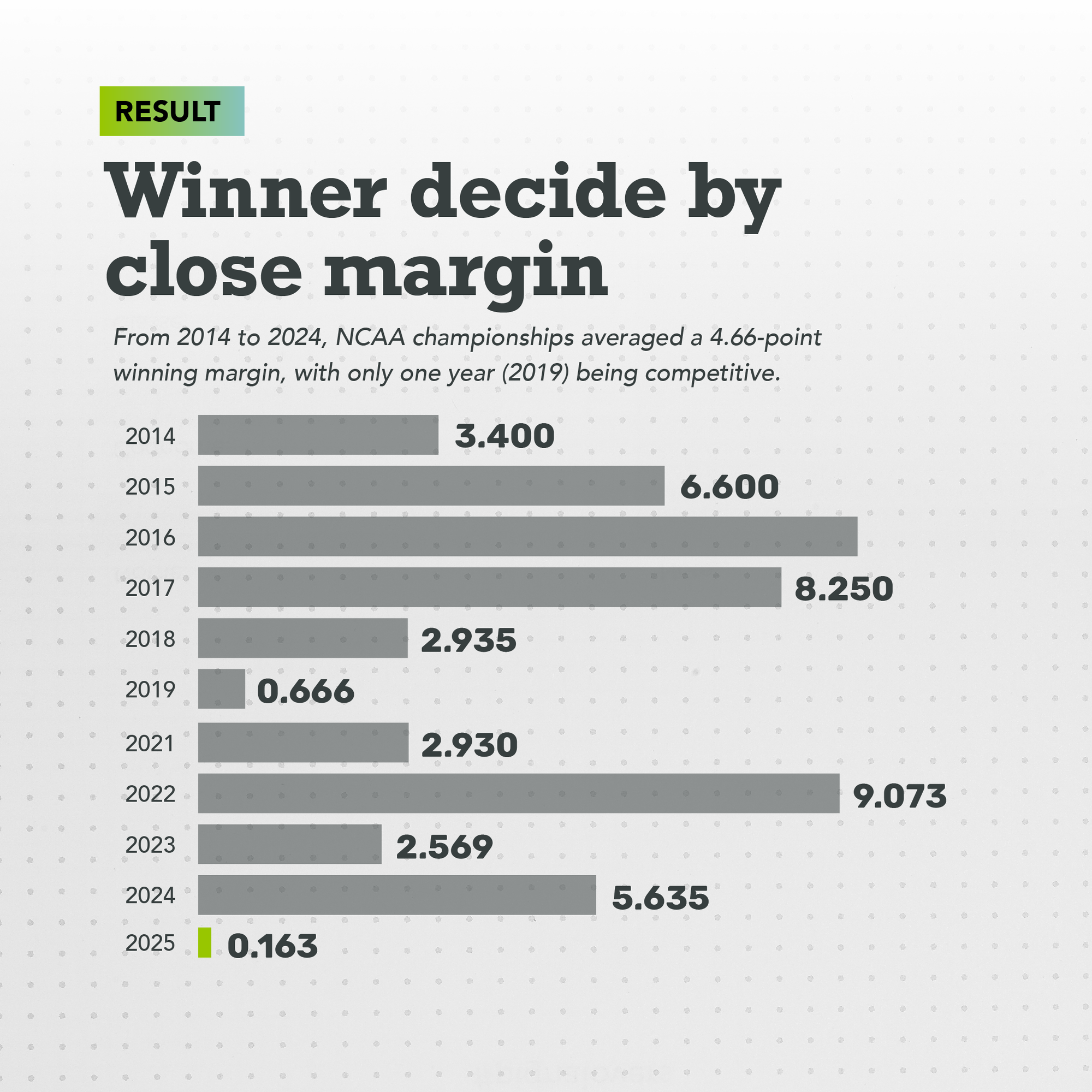
NCAA men’s gymnastics is facing serious challenges, most notably the steady decline in collegiate programs as more schools eliminate their teams. Yet, a less frequently discussed issue is the growing perception that NCAA competitions have become somewhat stale and lacking excitement. Until 2025, large point margins often decided NCAA championship titles. From 2012 to 2024, the top two teams averaged a 4.66-point difference, and in 2016 and 2022, the margin exceeded 9 points. To put this into perspective, a single fall deducts just one point, so in these competitions, the winner was basically determined well before the final rotations even started.
NCAA men’s gymnastics has always featured highly difficult routines and talented athletes. Over the years, it has showcased world-class performances from stars like Steven Legendre on floor, Anthony McCallum on vault, and Curran Phillips on parallel bars. However, the format failed to generate suspense as seen in other sports, like the 2022 FIFA World Cup final going to penalties after a dramatic 3-3 draw, Team USA edging out host country France by a single point to win basketball gold, or world no. 123 tennis player Luca Nardi took down world no. 2 Novak Djokovic in an upset.
From 2014 to 2024, the top-ranked team entering the NCAA Championships claimed the title 70% of the time. In the remaining instances, the second-ranked team claimed the championship. For over a decade, the title predominantly bounced back and forth between Stanford and Oklahoma, creating a pattern of dominance that lacked the unpredictability and excitement fans crave in sport.
Note: This issue has concerned coaches for years. In 2013, former Illinois head coach Justin Spring proposed a new dual meet format to address it. The format failed to gain popularity, and it was never implemented.
The 2025 season, however, ushered in a new era of excitement, fueled by changes in both the NCAA format and World Gymnastics rules. Two rule changes in particular drove this transformation:
- New rules reducing the number of skills a gymnast performs, and
- Fewer routines per team
New rules resulting in shorter routines with more challenging skills.
After the 2024 Olympics, World Gymnastics reduced the number of skills that count toward a routine’s score from 10 to 8. This made routines shorter and pushed gymnasts to include higher-difficulty skills, and since endurance mattered less, big elements became more feasible. Under the 2024 code, a D-rated dismount (0.4 difficulty value), such as a full-twisting double layout on high bar, earned 0.5 element group value (EGV). However, in 2025, the rules changed so that the EGV now matches the dismount's difficulty value. So, the same D dismount now earns just 0.4 EGV.Under the new system, a D-rated dismount adds just 0.8 to a routine's difficulty score, while an F-level dismount now adds 1.2 points (0.6 EGV + 0.6 for difficulty) to a routine’s value. As a result, routines featuring big skills and challenging dismounts, like the Andrianov (triple back), became the highlights of the 2025 championships. Taylor Burkhart from Stanford and Carson Eshleman from Michigan successfully performed the skill.
Team format changes increased competition.
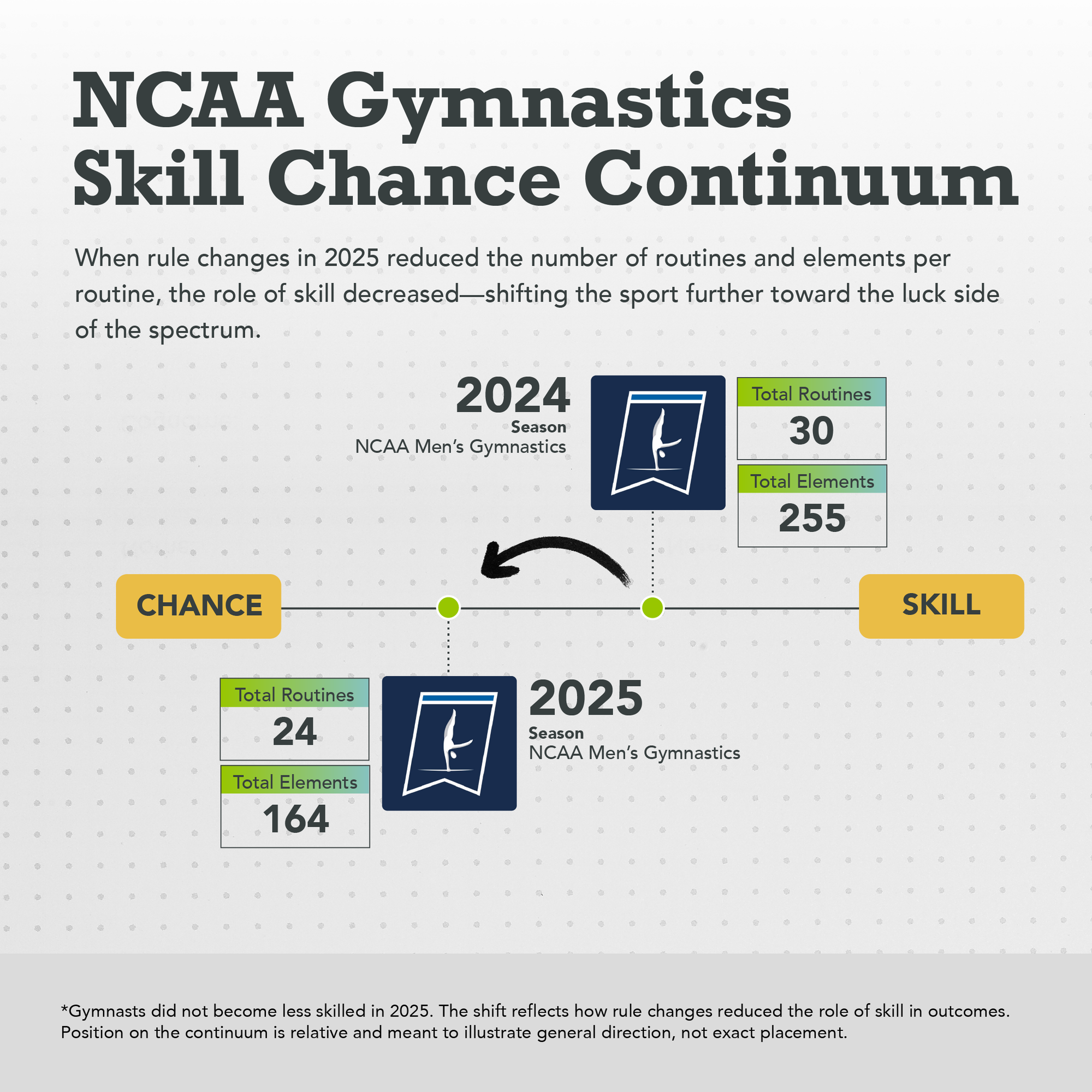
Arguably, the most significant rule change for 2025 was the reduction of the number of counting routines per event from five to four, cutting six routines from each meet. Meaning, the total number of counted skills for a team's final score dropped to 164, a reduction of 91 skills.
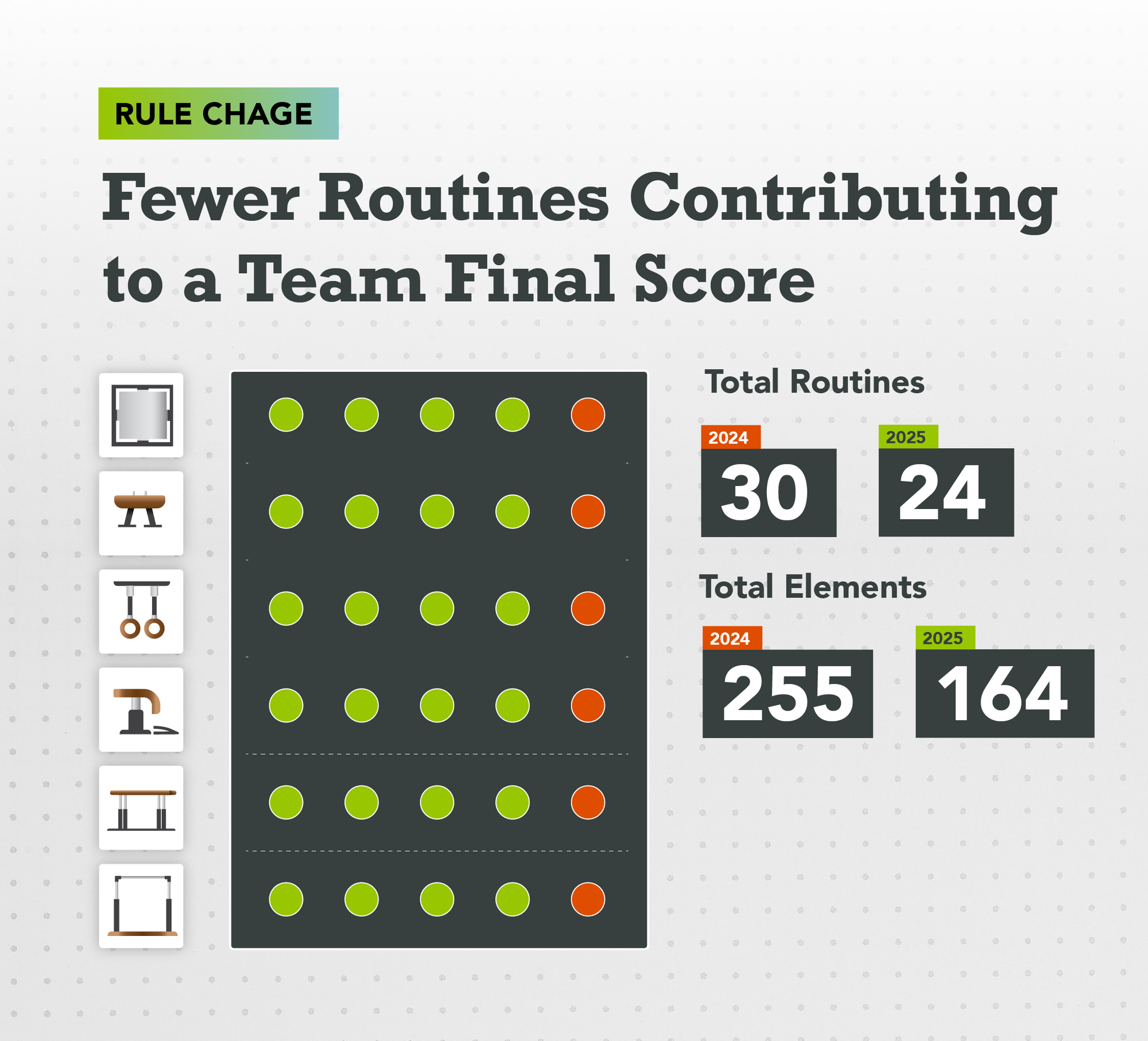
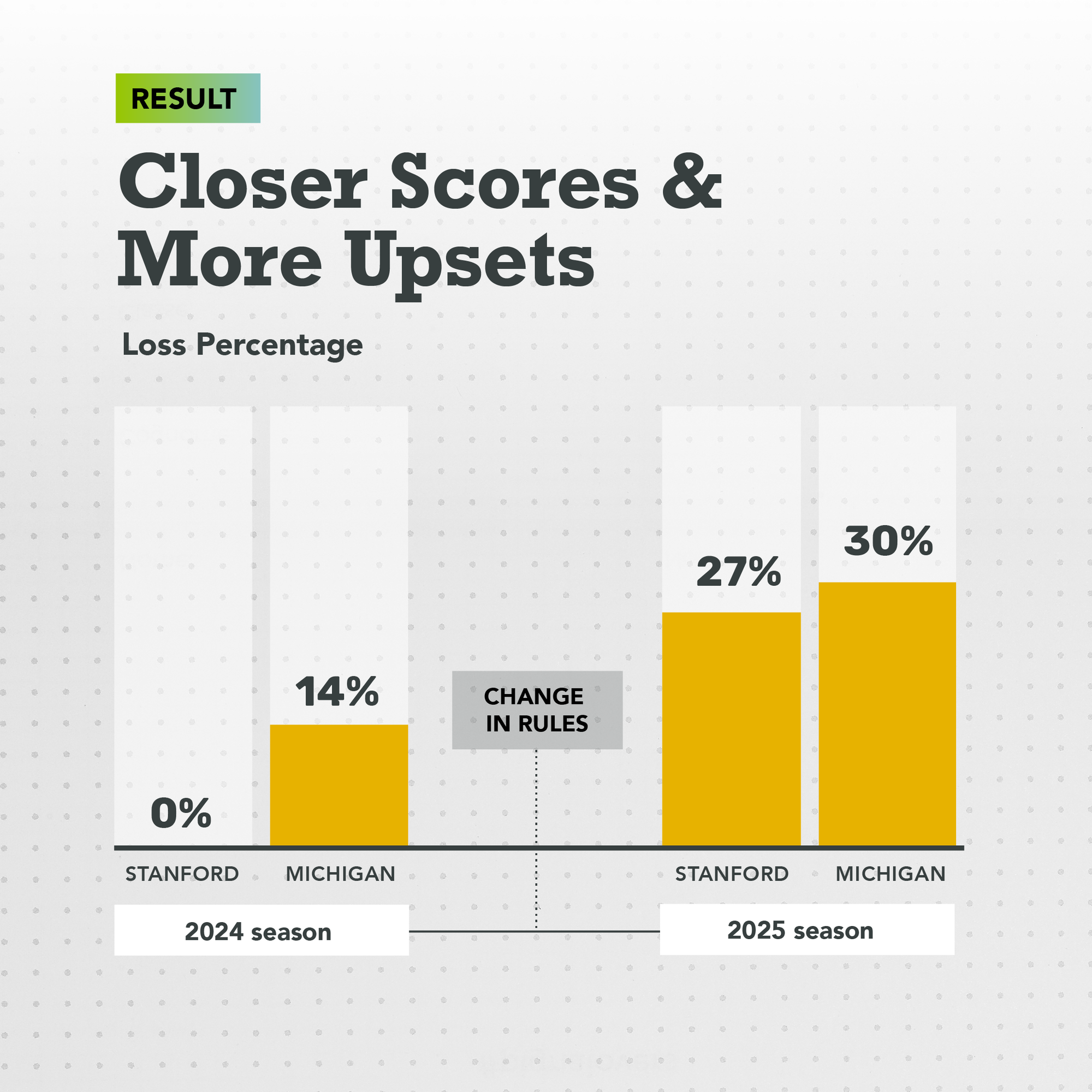
As a result, finals scores became closer and the gap between teams shrank, creating a more competitive environment. This outcome is grounded in basic statistics: the more routines and skills that contribute to the data set (the team’s total score), the more closely the average score captures a team’s “true performance ability”. When there are fewer routines and skills, outlier scores, such as a fall or an unusually stellar routine, have a bigger effect on the team total. This greater variability was evident in 2025 when the top two teams lost 30% of their meets.This idea reflects Michael Mauboussin’s concept from The Success Equation, which examines the balance between luck and skill in sports. Mauboussin contends that variability, the unpredictability of outcomes, is central to the excitement of sports, but it also means the “best” team doesn’t always come out on top. He places sports on a spectrum: at one end, luck (or unpredictability) and on the other, skill. The NBA’s long 82-game season builds a large dataset, allowing teams’ true performance ability to emerge over time, while the NFL’s shorter 16-game season leaves more to chance, resulting in more frequent upsets.
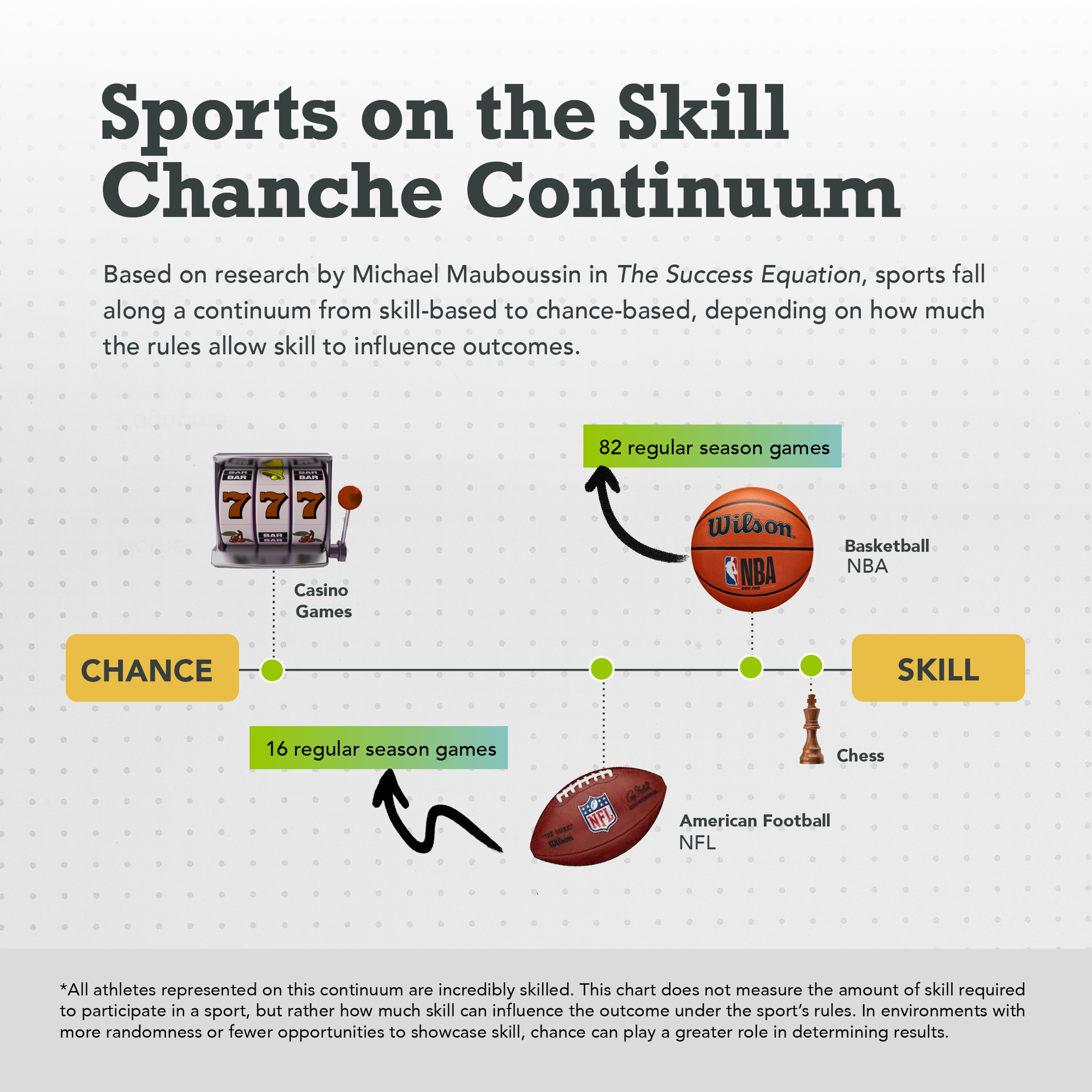
In NCAA men’s gymnastics, reducing the number of routines and skills counted narrows the score gap between teams but also boosts unpredictability. This not only makes results less certain and more thrilling, but also ensures that luck plays a greater role in determining the outcome.
How to measure success?
If a system that fails to capture a team’s true skill level is inherently flawed, would it not make more sense to use one that accurately assesses talent?
In events like the Olympic Games, the objective is to identify the best athlete with maximum precision. But for NCAA gymnastics, the goals can be different. NCAA sports are built on unpredictability and dramatic finishes, often valuing excitement over simply rewarding the most skilled athlete. Take NCAA basketball, March Madness is famous for its chaotic bracket, where underdogs can topple favorites and every game brings new drama. It’s this element of surprise that makes these events so compelling, turning each competition into an emotional thrill ride for fans.
An important consideration is how competition rules can be designed to intentionally narrow the skill gap between athletes. NCAA women’s gymnastics offers a clear example: routines are capped at a 10.0 start value, a threshold most top athletes can reach. Deductions are more forgiving, so small mistakes have minimal impact on scores. As a result, it’s harder to differentiate the best performances. For example, in 2017, six gymnasts tied for the NCAA uneven bars title, highlighting how the current system makes it difficult to distinguish true standouts. However, this also means that team competitions are incredibly close, often decided by tenths of a point—the difference of just a few stuck landings.
Adjusting rules and scoring systems alters the balance between skill and chance, ultimately shaping how we view competition and excellence. Some sports, by nature, involve more luck, but gymnastics team competitions are especially affected by their format. As seen in 2025, changes to how meets are organized can dramatically influence outcomes.
Before the season started, Inside Gymnastics shared insights from multiple coaches on their opinions about the new rule changes. Illinois head coach Daniel Ribeiro expressed enthusiasm, stating:
“I think it’s the most incredible change we’ve ever made.” - Daniel Ribeiro
Not all coaches shared Ribberio’s optimism. Oklahoma head coach Mark Williams responded critically, saying, “Do I like it? No. I think it takes away opportunities for gymnasts across the country that we absolutely will not get back, and I worry about it having a trickle-down effect on the number of kids who stay in, or ever start, the sport.” Williams expressed concern over smaller routines and reduced roster sizes, remarking:
“Continually taking action to make ourselves smaller and smaller, to me, defeats the team competition aspect of college athletics, and in some ways feels like we’re eliminating ourselves.” - Mark Williams
Williams’ concerns are well-founded, as the new rules have indeed restricted participation opportunities for NCAA gymnasts. Still, these changes also made the 2025 season far more competitive and exciting to watch. This surge in excitement could help broaden the sport’s appeal and attract new fans.
Before the 2025 season, the NCAA and ESPN took a major step forward by securing an eight-year media rights agreement. This deal guarantees that the men's NCAA championships will remain televised through at least 2032. If the rule changes result in higher viewership and greater meet attendance, the advantages could ripple across individual teams and elevate the sport as a whole. It’s still too early to determine if there will be any long-term effects, but the 2025 season brought an exceptional level of close competition that hadn’t been seen in years.
Author

Gabriel is a former NCAA gymnast, who represented the University of Nebraska from 2009 to 2013. He has also judged at the JO and NCAA level.
Sign up for Auric Gymnastics newsletters.
Stay up to date with curated collection of our top stories.