1. Are there weight classes in gymnastics?
Unlike weightlifting or combat sports, gymnastics does not have weight classes or rules regarding an athlete's weight. Gymnasts of various body types have found success in the sport. However, weight-related pressures have been a prevalent issue in gymnastics worldwide.
The International Gymnastics Federation (FIG) has had to intervene in cases of weight shaming and abuse. For example, the Azerbaijan Gymnastics Federation was fined CHF 30,000 for instances of physical abuse against athletes, including beating them over weight gain.
Additionally, the World Anti-Doping Agency (WADA) has sanctioned gymnasts, such as Daiane dos Santos (BRA) and Dipa Karmakar (IND), barring them from competition for using weight loss drugs.
One of the sport's most tragic cases is that of Christy Henrich, a former U.S. elite gymnast who passed away in 1994 at the young age of 22 due to complications from anorexia.
If you or someone you know is struggling with an eating disorder, please reach out for help. The National Association of Anorexia Nervosa and Associated Disorders (ANAD) offers support at 1-630-577-1330.
2. What is the hardest skill in men’s gymnastics?
The Code of Points, the definitive guide for assigning value to gymnastics skills, rates every skill with a letter from A to J, with each letter representing an increment of 0.1 in difficulty. For example, an “A” skill, which is considered basic, is worth 0.1 points, while a “D” skill is worth 0.4 points. Each subsequent letter in the sequence adds another 0.1 points to the skill's difficulty value.
In the current Code of Points, two skills hold the highest difficulty rating of "J," worth a full 1.0 point. Both of these skills are performed on the floor exercise.
| Event | Name | Description | Video |
|---|---|---|---|
| Floor | Nagornyy | Triple salto backward, piked | 2021 European Championships |
| Floor | Jarman | Double salto backward, straight with 7/2 twist | Apparatus World Cup, Paris 2023 |
Vault, however, is judged differently from the other five events and is assigned a flat difficulty score. At present, the most challenging vaults are rated at 5.6 points in difficulty.
| Event | Name | Description | Video |
|---|---|---|---|
| Vault | Yonekura | Round-off (Tsukahara), straight with 7/2 twist | Apparatus World Cup, Melbourne 2019 |
| Vault | Ri Se-gwang | Handspring forward, double piked salto forward with 1/2 turn | 2015 World Championships, Event Final |
| Vault | Ri Se-gwang 2 | Double Tsukahara with 1/1 twist | 2015 World Championships, Event Final |
Many consider Igor Radivilov’s vault (https://www.youtube.com/watch?v=tM0a7bTVUy0) at the 2016 Olympic Games vault final to be one of the most difficult vaults ever attempted. He performed a handspring triple forward vault, though he was unable to land it successfully. Following the competition, the FIG (International Gymnastics Federation) banned this vault from future events due to the extreme danger it posed and the potential risk to athlete safety.
3. What happens if a gymnast falls during a routine?
When a gymnast falls during a routine, a 1.0-point deduction is applied to their execution score. Additionally, they may not receive credit for the skill they fell on, which can lower their difficulty score as well.
4. How are gymnastics scores calculated?
Gymnastics scores are composed of two key components: the Difficulty Score (D Score) and the Execution Score (E Score). The Difficulty Score is determined by the combined value of the top eight skills performed in a gymnast's routine. Meanwhile, the Execution Score starts at a perfect 10.0, with judges deducting points for any errors in execution. Together, these scores reflect both the complexity and precision of the performance.
5.How can a gymnast get their name in the Code of Points?
To have a skill named after you in the Code of Points, you must be the first gymnast to successfully perform it at a major international competition, such as the World Cup, World Championships, or the Olympic Games. The detailed requirements for this achievement are outlined in Article 5.8 of the Men’s Code of Points, under "MAG Naming of New Elements." The key criteria are as follows:
- The skill must be performed internationally for the first time at an official FIG Group 1, 2, or 3 competition.
- The skill must have a difficulty value of "C" or higher and be executed successfully without a fall.
- If multiple gymnasts perform the same new skill at the same competition, the skill will be named after all of them.
By meeting these criteria, gymnasts can secure a legacy in the sport by having their name immortalized in the Code of Points.
6. What is the men’s gymnastics uniform?
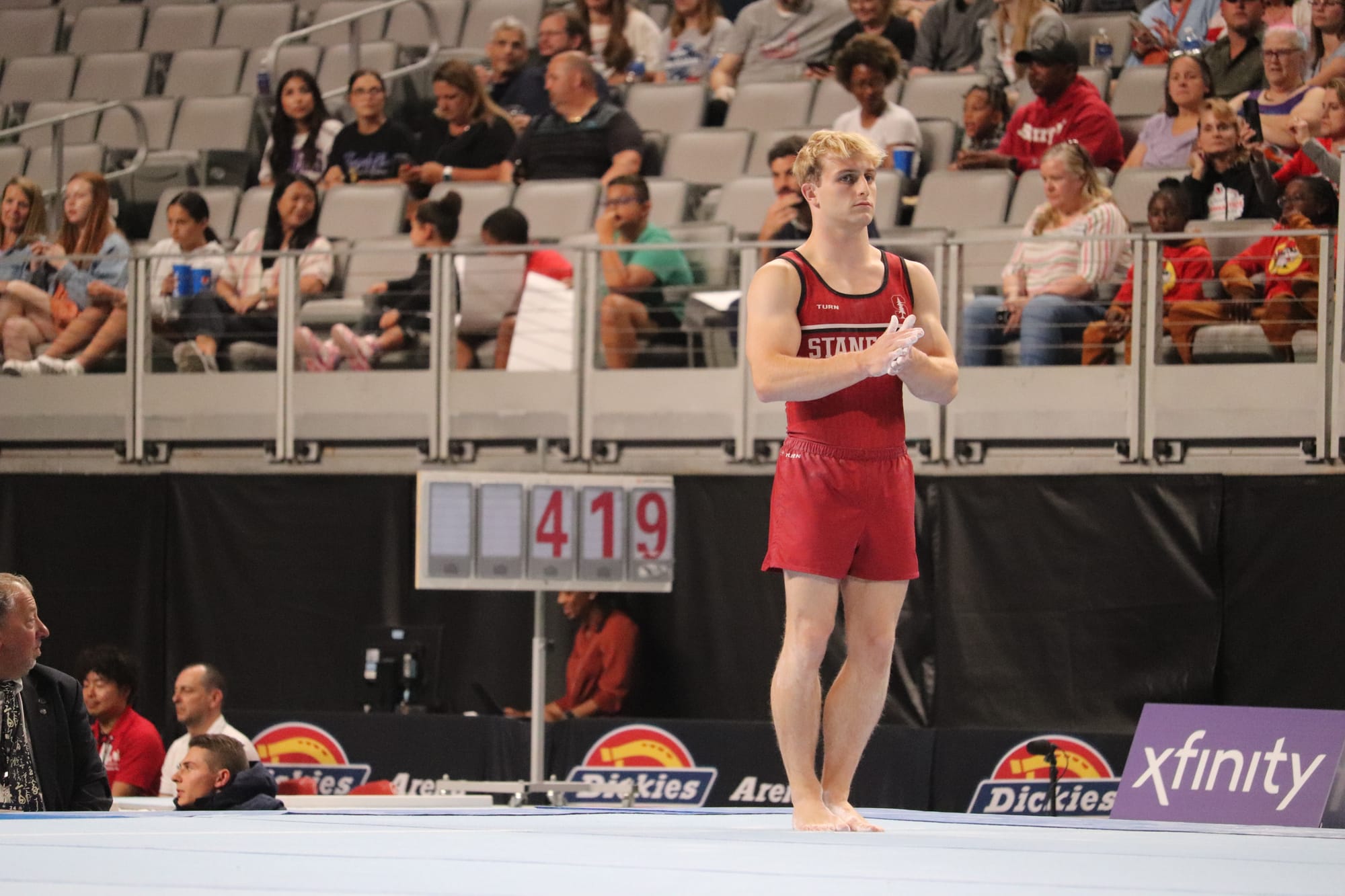
The foundation of a men’s gymnastics uniform is the step-in, a garment that covers the athlete’s upper body and chest, resembling the design of a wrestling singlet. For the lower body, gymnasts have two options: shorts or pants. Shorts are typically worn during floor and vault routines, while pants are required for events like the pommel horse, still rings, parallel bars, and high bar. When wearing pants, gymnasts must also wear socks. For floor and vault routines, gymnasts have the option to wear specialized gymnastics shoes, although these are not mandatory.
Some of the leading companies specializing in men's competitive uniforms are GK and Turn.
7. What are Gymnastics Grips?
In men’s gymnastics, grips are essential tools used on the still rings and high bar. These grips are secured to the gymnast’s wrists using either Velcro or buckles and feature a piece of leather that extends roughly the length of the gymnast's hand. At the top of the grip, there are finger holes, allowing the grip to rest on the top joint of the fingers.
To create a curved shape that wraps securely around the apparatus, the inside of the grip contains a small dowel sewn into the leather. The key difference between ring grips and high bar grips lies in their design: ring grips have a larger dowel and two finger holes (for the middle and ring fingers), while high bar grips have a smaller dowel and three finger holes (for the middle, index, and ring fingers).
8.What is the deduction for a gymnast bending their legs?
Under the Code of Points, execution errors like bending the arms, legs, or body are evaluated based on the degree of angular deviation. Deductions are applied as follows:
- Slight bending: Greater than 0° but up to 45° (0.1 deduction)
- Significant bending: Greater than 45° but up to 90° (0.3 deduction)
- Severe bending: Greater than 90° (0.5 deduction and no element recognition)
9.What happens if a gymnast steps out of bounds during a floor routine?
Under the Code of Points, stepping or placing one foot or hand outside the designated area results in a -0.10 deduction. If both feet, both hands, a combination of a foot and hand, or any other part of the body touch outside the boundary, the penalty increases to -0.30. Similarly, landing completely outside the floor area also incurs a -0.30 deduction.
10. What is the age requirement for elite gymnastics?
To compete in major senior competitions, such as the Olympic Games or World Championships, male gymnasts must turn 18 during the competition year. For female gymnasts, the age requirement is lower—they must turn 16 in the year of the competition.
Author

Gabriel is a former NCAA gymnast, who represented the University of Nebraska from 2009 to 2013. He has also judged at the JO and NCAA level.
Sign up for Auric Gymnastics newsletters.
Stay up to date with curated collection of our top stories.