Nadia Comaneci of Romania famously earned the first perfect 10 in Olympic gymnastics history at the 1976 Montreal Games. The scoreboards, unable to display a 10.0, showed a 1.00 after her bars routine. Later in the competition, Nellie Kim also achieved a perfect 10 on vault. However, no male gymnast at the 1976 Games received a perfect score.
While awarding a 10 was not unheard of, the website Gymnastics History has researched this topic and found that male gymnasts received perfect scores in various competitions as early as the mid-20th century. For example, during a 1952 dual meet between the Soviet Union and Hungary, Soviet gymnast Dmytro Leonkin earned a perfect 10 on rings, and his teammate Viktor Chukarin matched the score on pommel horse. However, it was not until the all-around final at the 1980 Moscow Olympics that a 10.00 was awarded to a male gymnast at the Olympic Games.
The 1980 Olympics were unusual, as more than 60 countries joined the U.S.-led boycott to varying degrees. This meant that the gymnastics competition was missing Team Japan, who had won the event at every Olympics since 1952, as well as the U.S. team, who had medaled in the team competition at the 1979 World Championships. However, the Soviet Union fielded an incredibly strong team, including reigning world all-around champion Alexander Dityatin and 1976 Olympic star Nikolai Andrianov. In the first medal event, the team final, the Soviets defeated East Germany by more than eight points.
After leading the field in qualifiers and compulsories with 118.4 points, just ahead of his veteran teammate Nikolai Andrianov (118.15), Alexander Dityatin continued his strong performance in the all-around final. He earned consistently high marks across all his routines. Dityatin made history by receiving a perfect 10.0 for his vault, becoming the first male gymnast to achieve a 10.0 at the Olympic Games.
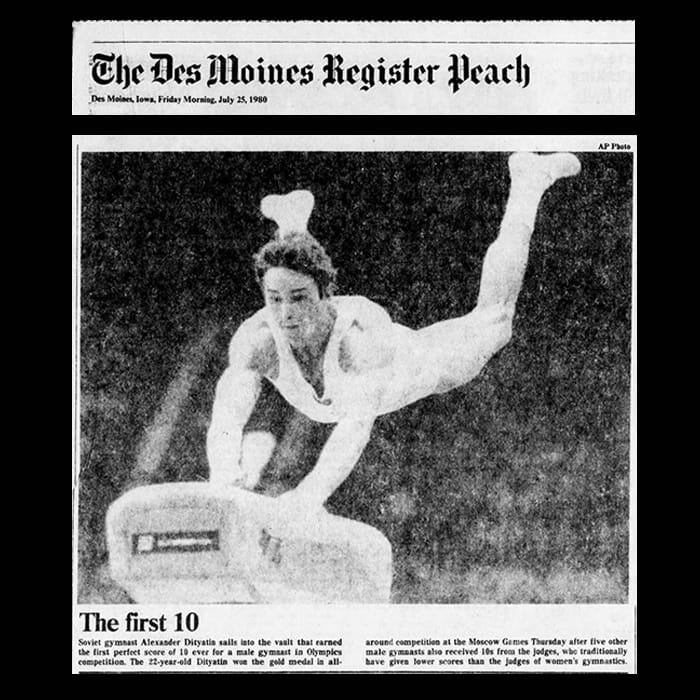
Perhaps aided by rotation order or the support of the home crowd, Dityatin’s milestone seemed to spark a trend: five different gymnasts would go on to score perfect 10s during the all-around competition. Germany’s Michael Nikolay scored a 10.0 on pommel horse, Soviet Alexander Tkachev earned one on high bar, Stoyan Deltchev of Bulgaria received a 10.0 on rings, and Zoltan Magyar of Hungary matched the feat on pommel horse. Ultimately, Dityatin went on to win the all-around competition, finishing with a total score of 118.65.
These results were not without controversy. At the time, the Associated Press wrote on July 25, 1980: “After Dityatin, four other 10s were awarded, raising some concern that easier standards were being applied to judging at the Moscow Games.” The press also noted that “Judges in men’s events traditionally have been more conservative than those in women’s competitions.”
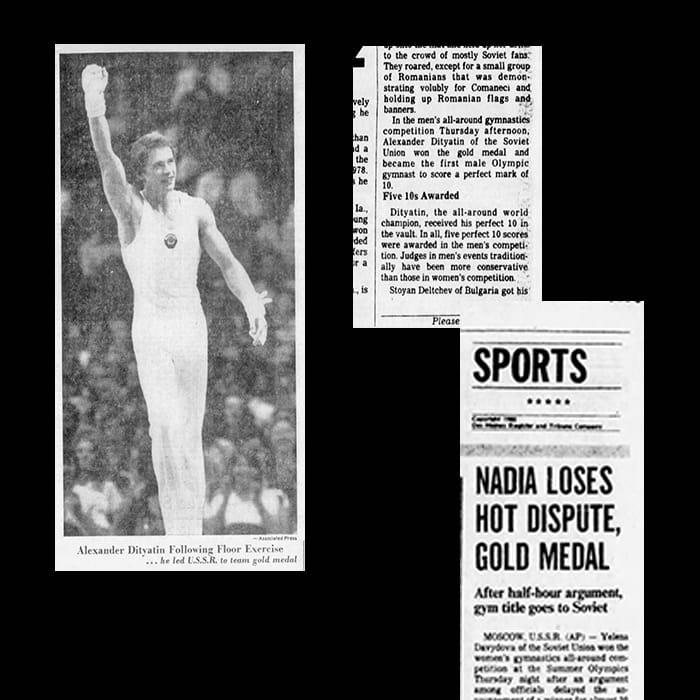
At the same time, controversy surrounded the judging in the women’s all-around competition, where Nadia Comaneci was awarded the silver medal. The Associated Press attributed the results in part to “unusual scoring.” Fred Rothenberg of the AP also published an article titled “Judge’s Honor Questioned” following Comaneci’s second-place finish. Even in modern Olympics, judges’ scores continue to spark debate. However, in the decades since the Moscow Games, no evidence of foul play or quid pro quo has ever been revealed.
As journalist Dvora Meyers wrote in her book The End of the Perfect 10, "perfect" was never an accurate term for a 10.0 score. Many historic “perfect 10s” were awarded despite minor form breaks, shuffles, or steps on landing, even Comaneci had a small shuffle forward on her historic bars routine. When reviewing Dityatin’s vaults today, the available footage clearly shows that Dityatin tended to bend and separate his legs on the entry, and land with a low chest, both issues that would result in deductions under the current Code of Points. Nevertheless, Dityatin’s performances throughout the Moscow Games were remarkable: he scored no lower than 9.800 out of 10 across 24 routines, and in 18 of those, he earned at least a 9.900. At those Games, he became, and remains, the only male gymnast in Olympic history to win a medal in all eight men's events.
Strangely, despite research, it has not been possible to determine exactly which vault earned Dityatin the historic 10.0, nor is there confirmed footage of this vault. While some video exists of Dityatin performing vaults at the 1980 Games, it remains unclear whether these are from the team, all-around, or event finals. Dityatin performed two different vaults in Moscow: a Tsukahara layout, likely for his compulsory vault, and a handspring with tucked front with ½ turn. Both of these vaults were rated as “C” in that era's code of points (again, thank you to Gymnastics History), giving a base score of 9.8 and having the potential to earn a 10.0 after factoring in the scored components of “Risk”, “Originality”, and “Virtuosity.”
Editor’s Note: If you have any reliable sources confirming the specific vault Dityatin performed for his perfect 10.0, or if you know of any existing footage, please get in touch.
Author

Gabriel is a former NCAA gymnast, who represented the University of Nebraska from 2009 to 2013. He has also judged at the JO and NCAA level.
Sign up for Auric Gymnastics newsletters.
Stay up to date with curated collection of our top stories.